
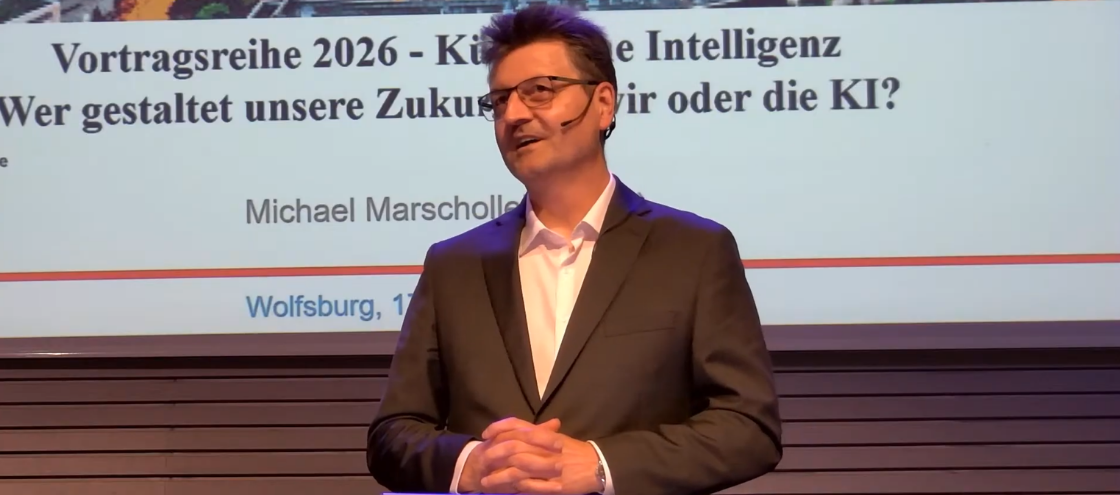
What can artificial intelligence achieve in medicine, and what are its limitations? That's what Prof. Dr. Michael Marschollek discussed on September 17, 2026, at the phaeno Science Center in Wolfsburg. The focus was on current research at CAIMed and the question of how AI can contribute to better, personalized healthcare.
Under the title “Artificial Intelligence in Medicine: What Works and What Doesn’t?”, Marschollek provided insights into the research being conducted at the Lower Saxony Research Center for Artificial Intelligence and Causal Methods in Medicine. He highlighted the opportunities that innovative AI methods open up for patient care and the role they can play in combating diseases such as cancer, cardiovascular diseases, and infections.
In addition to the potential benefits, the discussion also focused on technical and ethical issues: How can new methods be integrated into patient care? Where can AI already support day-to-day operations in hospitals and doctors’ offices? And where does human expertise remain indispensable? The presentation thus addressed key questions at the intersection of research and medical practice.
The event was part of the four-part public lecture series “Who Shapes Our Future—Us or AI?”, organized by the Braunschweig Scientific Society (BWG) and the Lower Saxony Academy of Sciences in Göttingen (NAWG). The lecture, held in the Science Theater at phaeno, was also livestreamed on YouTube.
For more information about the lecture series, visit the phaeno Website