
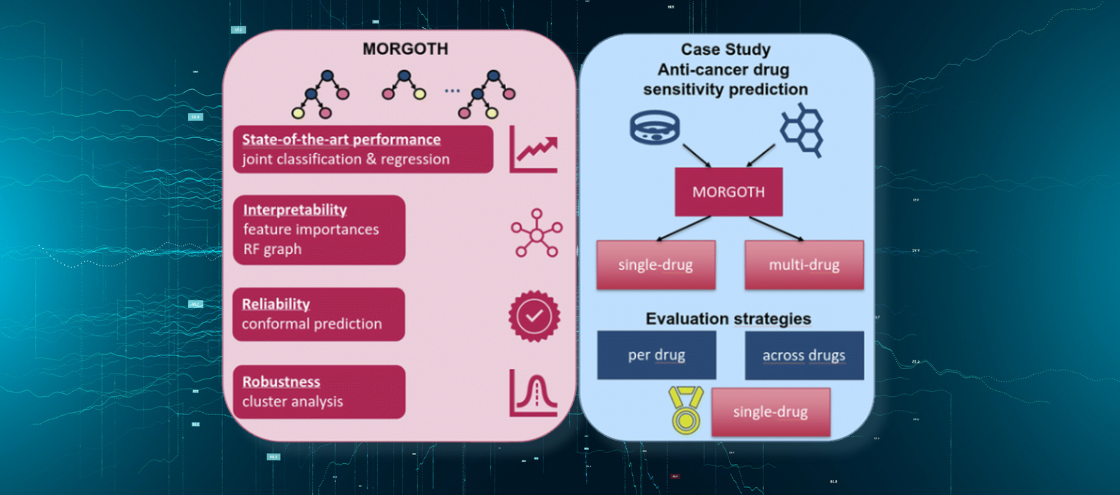
Which medication works for which patient? This is one of the central questions in oncology – and one that remains difficult to answer. Machine learning opens up new possibilities here, but for clinical use, predictive performance alone is not enough: doctors need to be able to trust a model’s output.
Genau hier setzt die neue Arbeit von Forschenden der Universität des Saarlandes, der University Medical Center Göttingen, ETH Zurich and CAIMed an. Das von ihnen entwickelte Verfahren MORGOTH verbessert nicht nur die Genauigkeit von Vorhersagen zur Medikamentenwirksamkeit, sondern macht auch transparent, wie sicher das Modell bei einer gegebenen Vorhersage ist. Für Behandlungsentscheidungen ist diese Nachvollziehbarkeit mindestens so wichtig wie die Vorhersage selbst.
The study also surfaces a methodologically relevant finding: previous comparisons between different model types contained a systematic bias – when evaluated on equal footing, results differ from what had previously been assumed.
MORGOTH is freely available to the research community as an open-source package. The paper was published open access in the journal Digital Discovery by the Royal Society of Chemistry.
Publication:Rolli et al. (2026). Increasing trustworthiness of machine learning-based drug sensitivity prediction with a multivariate random forest approach. Digital Discovery.
https://pubs.rsc.org/en/content/articlelanding/2026/dd/d5dd00284b