
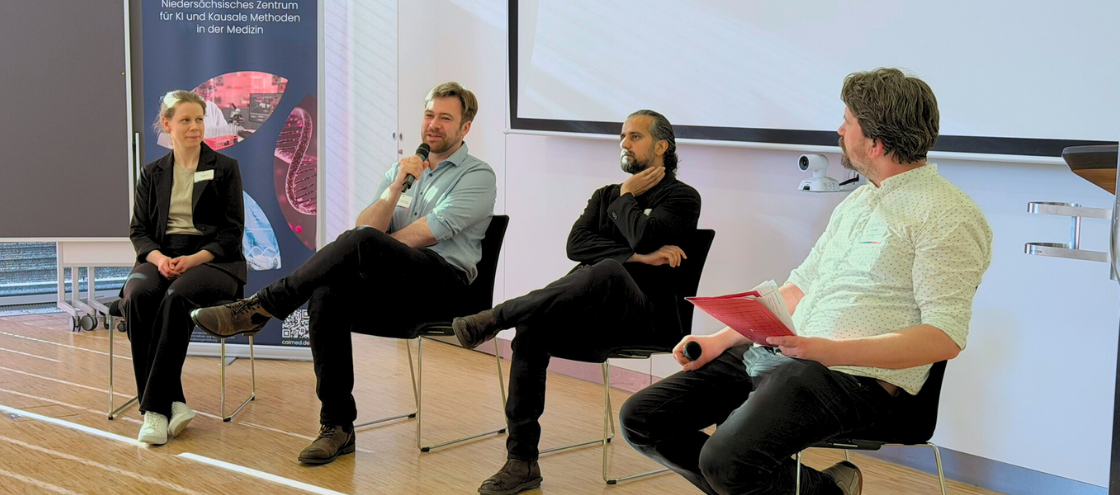
On March 2, 2026, the CAIMed Meet-Up “Clinical Decision Support and Its Statistical Evaluation: What, How, and Why?” took place at the Clinical Research Center (CRC) at Hannover Medical School (MHH). Researchers and clinicians gathered to discuss methodological, statistical, and ethical perspectives on the development and evaluation of clinical decision support (CDS) systems in AI-driven medicine.
Methodological and Statistical Perspectives
Dr. rer. med. Julia Böhnke opened the session with a presentation on diagnostic test accuracy estimation in longitudinal settings. Drawing on work from the ELISE project, she highlighted statistical challenges that arise when evaluating diagnostic performance over time and emphasized the importance of rigorous methodology for generating reliable evidence in clinical decision-making.
Prof. Dr. Björn-Hergen Laabs addressed the statistical foundations required for effective clinical decision support systems. His talk focused on key properties such as reliability, robustness, and practical applicability. Beyond commonly used performance metrics, he underlined the importance of sound statistical methodology to ensure that CDS systems can achieve meaningful impact in real-world clinical settings.
Responsible AI for Neurocognitive Technologies
Prof. Dr. Mehul Bhatt expanded the discussion by exploring responsible AI approaches for next-generation neurocognitive technologies. His presentation connected conceptual, ethical, and technological considerations and highlighted the importance of transparency, accountability, and interdisciplinary collaboration in the development of AI-based medical systems.
Panel Discussion and Poster Session
A panel discussion brought together the different perspectives and stimulated lively debate on evaluation standards, methodological challenges, and ethical considerations in clinical decision support.
The afternoon concluded with a poster session presenting ongoing research projects related to clinical decision support, AI in medicine, and statistical methodology. The format encouraged direct exchange between researchers, clinicians, and AI experts and provided insights into current work across the CAIMed network.
The discussions once again demonstrated how CAIMed Meet-Ups foster interdisciplinary collaboration and contribute to advancing trustworthy AI solutions for clinical practice. Further events are already being planned.