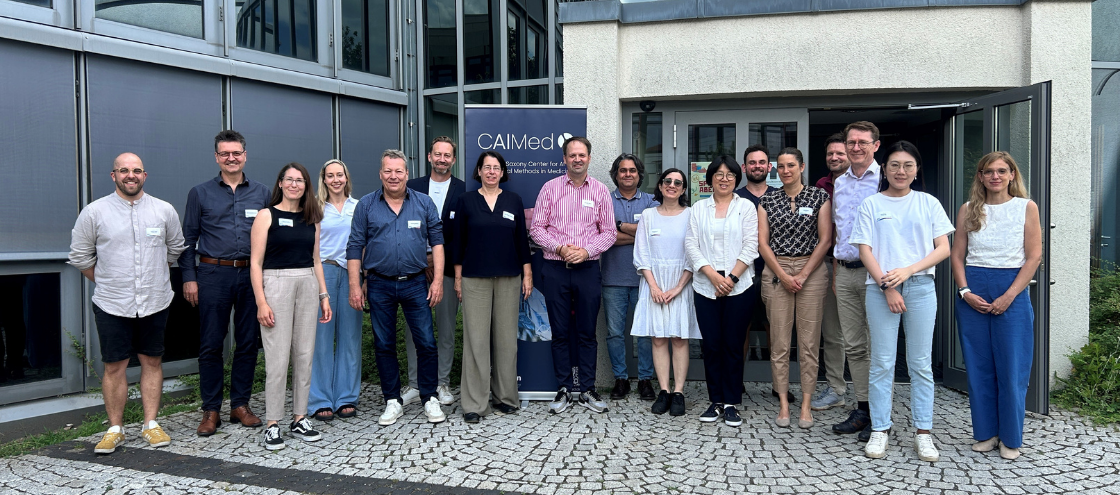
How can promising AI innovations successfully make the journey from research to clinical practice? This question was at the heart of the joint workshop hosted by CAIMed – Lower Saxony Center for AI and Causal Methods in Medicine and the Institute for Biomedical Translation (IBT) at the L3S Research Center in Hannover, together with experts from TRAIN – Translational Alliance in Lower Saxony.
The workshop brought together researchers, translational experts, and innovation partners to explore how cutting-edge medical AI can be systematically advanced toward real-world healthcare applications. Following welcome addresses by Prof. Dr. Wolfgang Nejdl, Prof. Dr. Michael Marschollek and Dr. Johannes Winter, IBT representatives Prof. Dr. Thomas Sommer and Dr. Heike Gielen introduced their translational support portfolio, including the PRE-SEED and EXPLORE funding programs, as well as practical tools such as Target Product Profiles, IP and Freedom-to-Operate (FTO) strategies, and milestone-based project planning. Sara Haag presented opportunities within TRAIN, highlighting the TRAIN Omics Days and TRAIN Academy as platforms for interdisciplinary exchange, training, and collaboration across Lower Saxony’s life science community.
A key focus of the afternoon was the presentation of current CAIMed research with strong translational potential. Dr. Maximilian Schieck (MHH) highlighted AI-supported approaches to identifying immune targets for Long COVID, while Prof. Dr. Thomas Jack (MHH) presented AI for early sepsis prediction. Dr. Zahra Ahmadi (MHH) showcased human-centered AI for cancer diagnostics and therapy. Martin Zielke (UMG) demonstrated how AI and biomarkers can advance digital pathology, and Dr. Sahamoddin Khailaie and Prof. Dr. Andriy Goychuk (HZI) presented mathematical models supporting Long COVID and ME/CFS diagnostics as well as AI-driven approaches to understanding complex biological systems. Each project was discussed with translational experts to identify validation pathways, clinical relevance, and opportunities for future implementation.
The workshop concluded with a discussion on collaboration opportunities and concrete next steps to accelerate the transfer of CAIMed innovations into clinical practice. A central message from IBT resonated throughout the event: successful translation starts early. For researchers, founders, and academic start-ups, considering clinical needs, intellectual property, regulatory requirements, and market potential from the beginning is essential for transforming excellent science into impactful healthcare solutions. Through initiatives such as PRE-SEED and EXPLORE, IBT provides dedicated support to help academic innovations bridge the gap between research and the market. The workshop underscored CAIMed’s commitment to combining outstanding AI research with translational expertise to ensure that scientific discoveries ultimately benefit patients and healthcare systems.